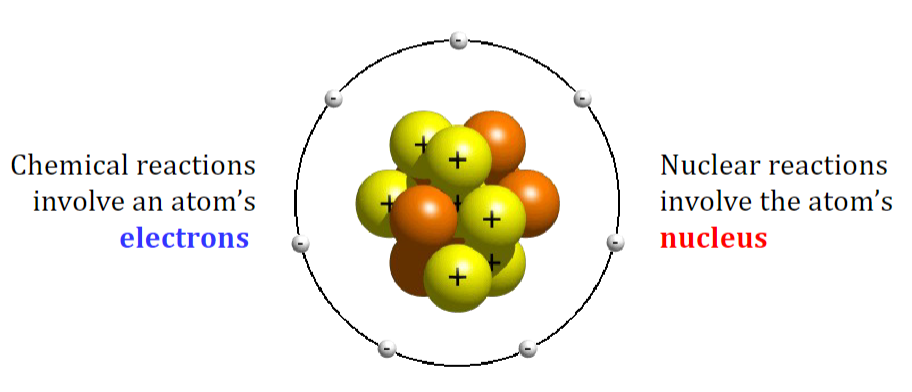
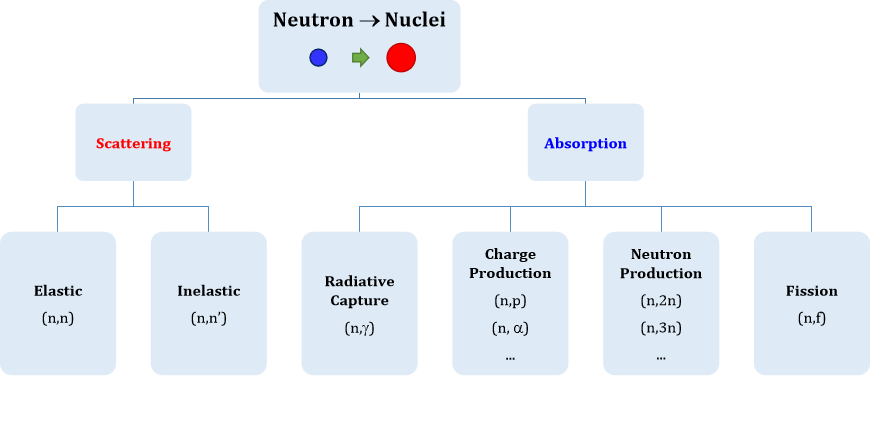
Nuclear reactions involves changes in the atom's nucleus
```col-md
- ##### Chemical Reaction
> $$\begin{matrix} \text{2CH}_{3}\text{OH}+3 \text{O}_{2}  \hspace{0.5cm} \rightarrow \hspace{0.5cm} \text{2CO}_{2}+\text{4H}_{2}\text{O}  \\  \\ \underline{\text{Combustion of Ethanol}} \end{matrix}$$
> - Mass of reactants ***equals*** mass of products
> - The same numer of each kind of atom appear in the ==reactants== and ==products==
> - The released energy is around ==$10^{-19} \text{J} \space  \begin{pmatrix}\approx \text{10 eV} \end{pmatrix}$== per reaction
>

```
```col-md
- ##### Nuclear Reaction
> $$\begin{matrix}^{1}_{0}\text{n}+^{235}_{92} \text{U} \rightarrow ^{236}_{92} \text{U} \rightarrow ^{144}_{56} \text{Ba}+^{89}_{36}\text{Kr}+3 ^{1}_{0}\text{n} \\   \\  \underline{\text{Fission of U-235}} \end{matrix}$$
> - Mass of reactants will *not* ***equal*** mass of products
> > - Elements may ***transmute*** into other elements
> - The released energy is around ==$10^{-13} \text{ J} \space  \begin{pmatrix}\approx  1 \text{ MeV} \end{pmatrix}$== per reaction
>

```
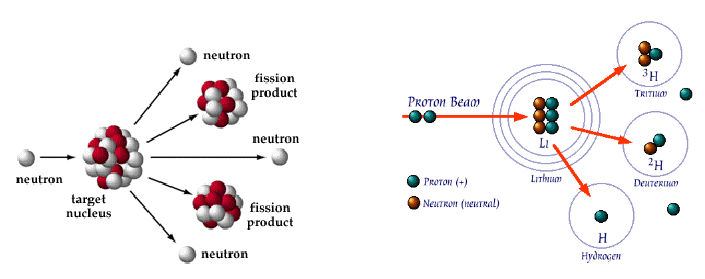
When the nuclei of an atom is tampered with, changes occur, resulting in a new different product
```col-md
flexGrow=1.5
===
- This new product may have changes in the ==composition==, ==energy== and/or ==momentum== of the target nucleus
> 
```
Applications of Nuclear Reactions
```col-md
- Understanding natural phenomena
> - Heat production in the sun
> - $^{14}\text{C}$ dating
- Production of radionuclides
> - $\text{Tc-99m}$
> - $\text{Co-60}$
> - $\text{Ir-192}$
- Radiation measurement
> - Neutron detectors: $\text{BF}_{3}$, $\text{He-3}$
- Radiation shielding
> - Photonuclear reactions
> - Neutron shielding
- Harness energy released in the reaction
> - Nuclear power plants
> - Fusion reactors


```
Nomenclature
```col-md

- Nuclear isotopes are written with
> $$\begin{matrix} ^{A}_{Z} X_{N} \end{matrix}$$
> $$\begin{matrix} \underline{\text{Carbon-14}}  \hspace{0.5cm} \rightarrow \hspace{0.5cm} \underline{^{14} \text{C}} \\  \\ \underline{\text{Helium-3}}  \hspace{0.5cm} \rightarrow \hspace{0.5cm} \underline{^{3} \text{He}} \end{matrix}$$
> - & $X$ is the symbol for element
> - & $A$ is the ==mass number==, which is $Z$ (protons) + $N$ (neutrons)

```
```col-md
flexGrow=2
===
- Nuclear particles
> | Particle| Symbol| Charge| Atomic mass no.|Mass $\text{(kg)}$| Mass $(\text{amu})$|
> |:---|:---:|:---:|:---:|:---:|:---:|
> | Proton| $\text{;p}^{+} \space  \space  \text{;p}$| $+1$| $1$| $-$ | $1.00727$|
> |Neutron| $\text{n}$|$\text{0}$|$\text{1}$|$-$|$1.00866$|
> |Electron / Positron| $;/;$|$-1/+1$|$0$|$-$||
> |Alpha| | $+2$|$4$||$4.0026$|
> |Beta||$-1$|$0$|||
> |Neutrino||$0$|$0$|| |
> |Photon||$0$|$0$|$0$|$0$|

```
```col-md
$$\begin{matrix} \fbox{Examples} \\  \begin{matrix} \\   \space \fbox{1}\space  & \text{Nuclear reaction to measure} \\  &  \text{neutrons with BF}_{3} \\  \\  &  \begin{matrix} ^{10}_{5} \text{B}+^{1}_{0}\text{n} \rightarrow ^{4}_{2} \alpha+^{7}_{3}\text{Li} \\  \\ ^{10}\text{B}(n,\alpha)^{7}\text{Li} \end{matrix} \\  \\  \\ \space \fbox{2}\space  & \text{Fission of U-235} \\  \\  & \begin{matrix} ^{1}_{n}+^{235}_{92} \text{U} \rightarrow ^{144}_{56}  \text{Ba}+^{89}_{36} \text{Kr}+3 ^{1}_{0}\text{n} \\  \\ ^{235}\text{U}(\text{n},\text{f}) \end{matrix} \end{matrix} \end{matrix}$$

```
```col-md
flexGrow=2
===
- One way to write nuclear reactions is by their atomic interactions
> $$\begin{matrix} \text{a}+\text{X} \hspace{0.5cm} \rightarrow \hspace{0.5cm} \text{Y}+\text{b} \\  \\ \text{or} \\  \\ \text{X}(\text{a},\text{b})\text{Y} \end{matrix}$$
> - & ==Projectile $(a)$==: Any nuclear particle or the lighter nucleus
> - & ==Target $X$:== Usually considered to be at rest and is the heavier nucleus
> - & ==Heavy Product Nuclide $Y$==
> - & ==Light Particle Ejectile $b$:== Lighter product ejected from the reaction which can be any nuclear particle or another nucleus
> - & ==$(a,b)$== indicates the type of reaction caused by what projectiles

```
Fundamental Laws Governing Nuclear Reactions
Conservation of Nucleons and Charges
```col-md

$$\begin{matrix}^{14}_{7}\text{N}+^{4}_{2}\alpha  \hspace{0.5cm} \rightarrow \hspace{0.5cm} ^{17}_{8}\text{O}+^{1}_{1}\text{H} \\  \\  \text{18 nucleons}=\text{18 nucleons} \\  \\ \text{9 protons}=\text{9 protons} \end{matrix}$$

```
```col-md
flexGrow=2
===
$$\begin{matrix} A_{a} & + & A_{X} & = & A_{Y} & + & A_{b} \\  \\ Z_{a} & + & Z_{X} & = & Z_{Y} & + & Z_{b} \end{matrix}$$
- The number of nucleic particles remain the same even as it rearranges into new heavier atoms

```
Conservation of Energy
```col-md
$$\begin{matrix} E_{a} & + & E_{X} & = & E_{Y} & + & E_b \end{matrix}$$
- The ==total kinetic energy $(E)$== is ***equal*** to the ==mass of the particle at rest $(mc^{2})$== before and even after the nuclear reaction
> $$\begin{matrix} E=mc^{2} \end{matrix}$$
> - This is crucial in predicting whether a certain reaction is *energetically possible*


```
```col-md
flexGrow=2
===
$$\begin{matrix} ^{A}_{Z}a+^{A}_{Z}X=^{A}_{Z}Y+^{A}_{Z}b \\  \\ \underline{E_{a}+m_{A}c^{2}} +\underline{E_{X}+m_{X}c^{2}} = \underline{E_{Y}+m_{Y}c^{2}} +\underline{E_{b}+m_{b}c^{2}} \\  \\ \underline{\begin{bmatrix}\begin{pmatrix}m_{X}+m_{a} \end{pmatrix}-\begin{pmatrix}m_{Y}+m_{b} \end{pmatrix} \end{bmatrix}c^{2}}=\begin{pmatrix}E_{Y}+E_{b} \end{pmatrix}-\begin{pmatrix}E_{X}+E_{a} \end{pmatrix} \end{matrix}$$
- The ==left hand side== of the equation gives the **Q-value** of the nuclear equation, with $c^{2} \approx  -931 \frac{\text{MeV}}{\text{amu}}$
> $$\begin{matrix} Q=\begin{bmatrix}\begin{pmatrix} m_{X}+m_{a} \end{pmatrix}-\begin{pmatrix}m_{Y}+m_{b} \end{pmatrix} \end{bmatrix}\begin{pmatrix} 931 \frac{\text{MeV}}{\text{amu}} \end{pmatrix} \end{matrix}$$

```
```col-md
> [!example]
> One of the reactions that occurs when $^{3} \text{H}$ (tritium) is bombarded by deuterons ($^{2} \text{H}$ nuclei denoted by $\text{d}$) is: $^{3}\text{H}(\text{d,n})^{4} \text{He}$
> ****
> ###### <center> Calculate the Q-value of this reaction

##### <center> 答える: </center>
- The Q-value is obtained from the following neutral atomic masses (amu):
> $$\begin{matrix} \begin{matrix}    m(^{3} \text{H})  & = & \text{3.016049 amu} \\     m(^{2}\text{H}) & = & \text{2.014102 amu} \\ \hline m(^{3}\text{H})  +  m(^{2}\text{H})  & = & \text{5.030151 amu} \end{matrix} \end{matrix}$$
> $$\begin{matrix} \begin{matrix}    m(\text{n})  & = & \text{1.008665 amu} \\     m(^{4}\text{He}) & = & \text{4.002603 amu} \\ \hline m(\text{n})  +  m(\alpha)  & = & \text{5.011269 amu} \end{matrix} \end{matrix}$$
>
> $$\begin{matrix} Q=\begin{pmatrix} \text{5.030151}-\text{5.011269} \end{pmatrix}\begin{pmatrix}931 \frac{\text{MeV}}{\text{amu}} \end{pmatrix} \\ \\ Q=\mathbf{17.59 \space  MeV} \end{matrix}$$
>
> - The positive value indicates this reaction is *exothermic 💥*


```
```col-md
flexGrow=1.5
===
$$\begin{matrix} Q=\begin{bmatrix}\begin{pmatrix} m_{X}+m_{a} \end{pmatrix}-\begin{pmatrix}m_{Y}+m_{b} \end{pmatrix} \end{bmatrix}\begin{pmatrix} 931 \frac{\text{MeV}}{\text{amu}} \end{pmatrix} \end{matrix}$$
- The reaction **$Q$ value** tells us whether the reaction is *exothermic* or *endothermic*

- ==If $Q>0$:== the reaction is *exothermic*
> - 💥Energy is ***released*** from the reaction
> - ⏫An ***increase*** in ==kinetic energy== is observed in the products (産む)
> - 📉*Net* ***decrease*** in ==mass==
> > *Because mass was converted into kinetic energy*

- ==If $Q<0$:== the reaction is *endothermic*
> - 🧽Energy must be ***supplied*** to initiate reaction
> - 📉***Decrease*** in kinetic energy
> - 📈*Net* ***increase*** in mass
> > *As kinetic energy is converted into mass*

```
```col-md
| Particle | Mass in kg | Mass in amu|
|:---:|:---:|:---:|
|Proton| $1.67252 \cdot 10^{-27}$|$1.00727646$|
|Neutron|$1.67482 \cdot 10^{-27}$|$1.00866492$|

```
```col-md
flexGrow=2
===
- The atomic mass scale $\text{amu}$ is based on the isotope, $^{12}\text{C}$ or 'Carbon-12'
> - Which has a mass of exactly 12 $\text{amu}$
> - $^{12} \text{C}$'s nucleus is composed of ==6 protons== and ==6 neutrons== that each has a mass greater than $1.0000000 \text{ amu}$
> > *Indicating that there is a mass difference*
> - ==Masses of all nuclei== are *smaller* than the ==sum of the individual nucleons==
> - This difference in masses is known to us as the **mass defect**
> > - Coincidentally, this glitch in the matrix is used as the equivalent mass to calculate the **nuclear binding energy**

```
The nuclear binding energy is the energy required to split the nucleus into individual nucleons
```col-md
##### Nomenclature:
- $Z$ is the ==atomic number== *(also the number of protons)*
- $m_{P}$ is the ==mass of the proton==
- $N$ is the ==number of neutrons==
- $m_{N}$ is the ==mass of the neutron==
- $M$ is the ==mass of the nucleus== *(found from the isotope browser)*
- $A$ is the ==mass number==

```
```col-md
flexGrow=2
===
- $E_{B}$ can be calculated from the ==mass defect $(\Delta m)$== using the mass relation
> $$\begin{matrix} E_{B}=\Delta m c^{2} \\  \\ E_{B}= \begin{bmatrix}Zm_{P}+Nm_{M}-M \end{bmatrix}c^{2} \end{matrix}$$
- Average binding energy per nucleon
> $$\begin{matrix} \overline{E}_{B}=\dfrac{E_{B}}{A} \end{matrix}$$

```
```col-md
- The image is a plot of ==$\overline{E}_{B}$== vs ==mass number==
- *Exothermic reactions* result in reaction products with ***increased*** binding energy
> - Going from ==less== to ==more stable nuclei==
- Two candidate reactions can befound based on the curve
> - Fission of heavy nucleus
> - Fusion of light nuclei
```
```col-md
flexGrow=2
===
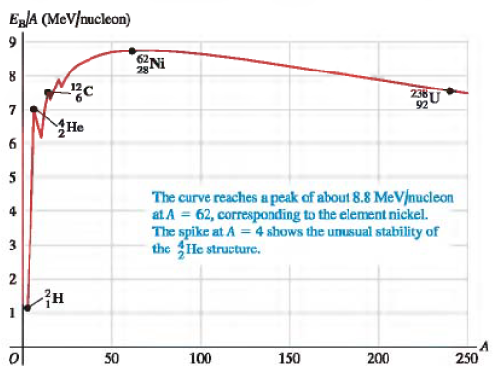
<i> <center> Binding energy per nucleon as a function of mass number </center> </i>
```
Types of Nuclear Reactions
The immense energy released in nuclear reactions is primarily due to the [[strong nuclear force]]
This is a fundamental force of the universe that is responsible for keeping the nucleus of atoms together
? Why?
According to Einstein's mass-energy equivalence equation , energy and mass are interchangeable
A small amount of mass can be converted into a large amount of energy
The strong nuclear force holds the protons and neutrons in a nucleus together
This binding energy is the energy required to break the nucleus apart
The difference in the binding energy of resulting nucleus after fission of fusion is released as energy
Fusion Reaction
```col-md
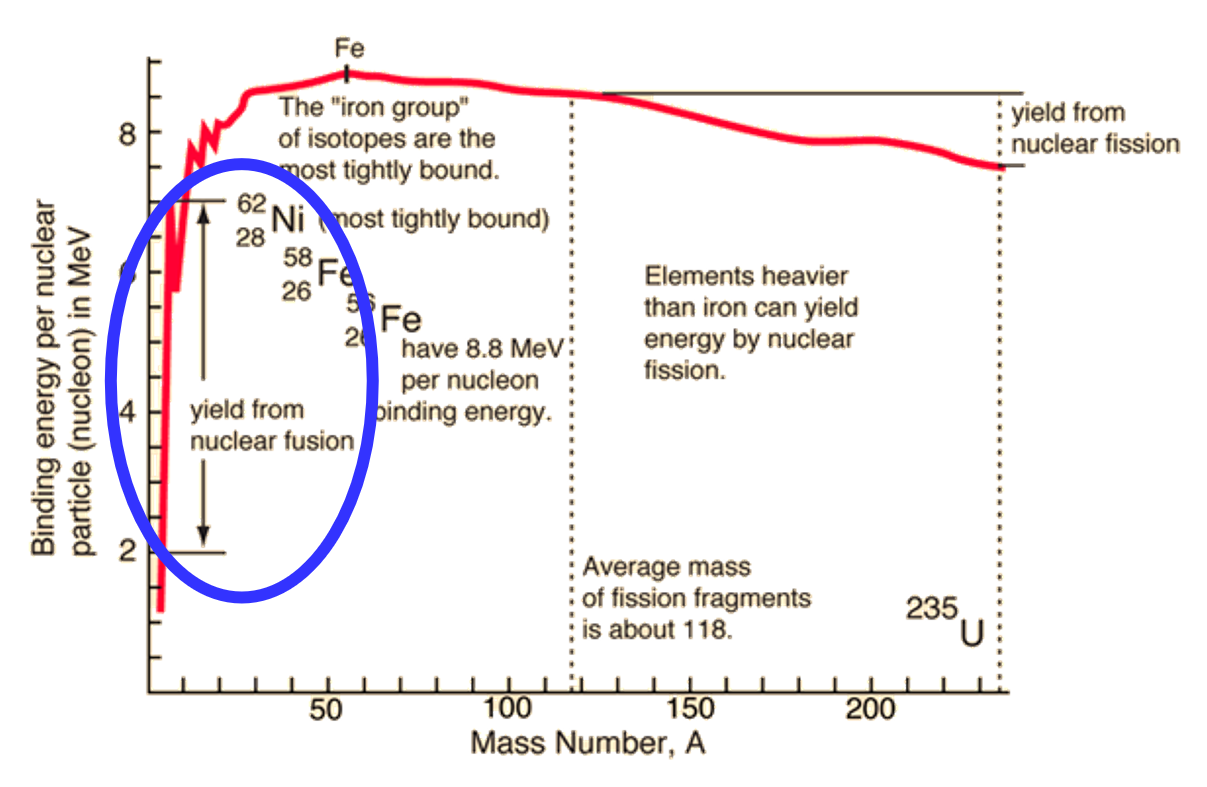
<i> <center> Binding energy per nucleon as a function of mass number </center> </i>
```
```col-md
flexGrow=1.5
===
- *Light nuclei* that are ***fused*** *together* will ***yield*** ==energy== because
> - & The mass of the combined nuclei will ALWAYS be LESS than the individual nuclei *(exothermic reaction)*
- Here are some common candidates for fusion reactions
> $$\begin{matrix} \underline{\text{D}- \text{D}} & ^{2}_{1}\text{H}+ ^{2}_{1}\text{H} \rightarrow ^{3}_{2} \text{He}+^{1}_{0}\text{n}+\text{3.25 MeV} \\ & ^{2}_{1}\text{H}+^{2}_{1}\text{H}\rightarrow^{3}_{1}\text{H}+^{1}_{1}\text{H}+\text{4.02 MeV} \\ \\ \underline{\text{D}-\text{T}} & \textcolor{pink}{\underline{\underline{ ^{2} _{1}\text{H}+^{3}_{1}\text{H}\rightarrow ^{4}_{2}\text{He}+^{1}_{0}\text{n}+\text{17.59 MeV}}}} \\ \\ & \textcolor{pink}{\begin{matrix} \text{More feasible at lower temperatures.} \\ \text{80\% of the energy released is in the} \\ \text{form of neutron kinetic energy.} \end{matrix}} \end{matrix}$$
> - Heavier atom fusions are not even remotely possible with current technology
```
Fission Reaction
```col-md
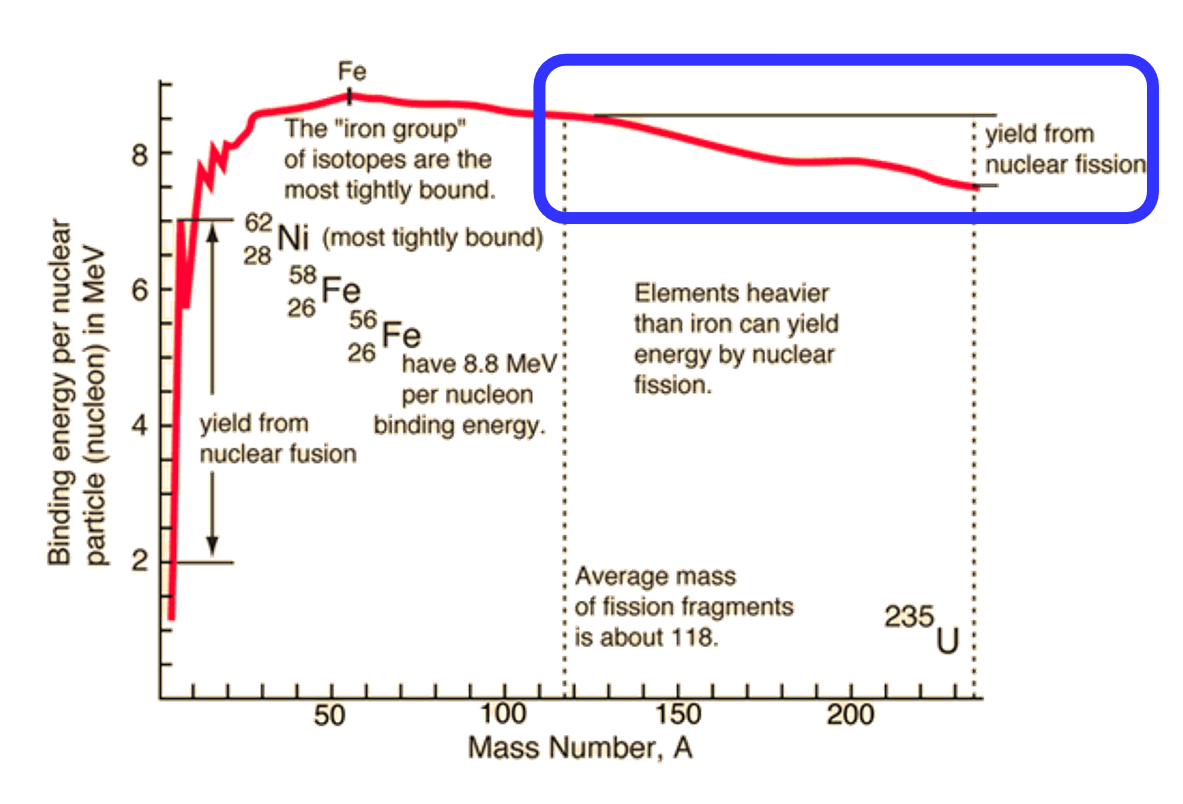
<i> <center> Binding energy per nucleon as a function of mass number </center> </i>
```
```col-md
flexGrow=1.5
===
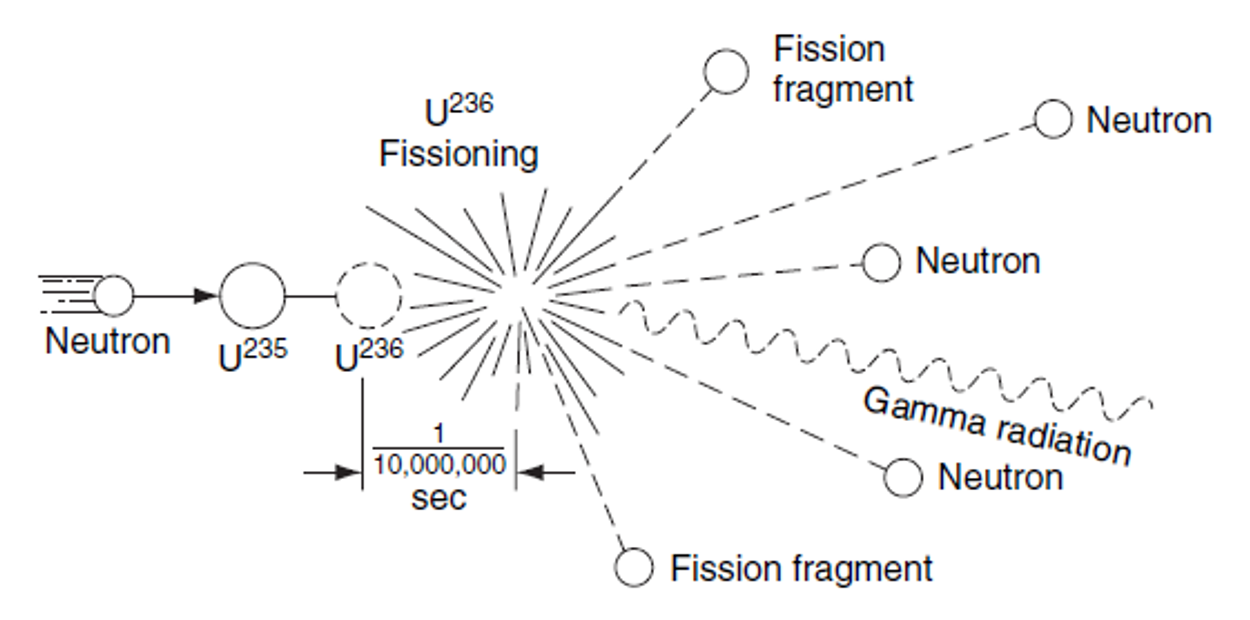
- The ***splitting*** of a *fissile nucleus* releases about ==$200 \text{ MeV}$ of energy== in the form of kinetic energy of the fission fragments, neutrons, and gamma rays
> - As well as that from the ==beta particles, gamma rays,== and ==neutrinos== ***emitted*** as the *fission products* undergo *radioactive* ***decay***
```
Fission vs Fusion
```col-md
| Quantity| Fission|Fusion|
|:---:|:---:|:---:|
|Energy (MeV) | ~200|~17.6|
|Atomic mass (g/mol)|238.029|5.030|
|Number of nuclei per kg (particles)|$2.5299 \cdot 10^{24}$|$1.19718 \cdot 10^{26}$|
|Energy released per kg (MeV)|$5.05989 \cdot 10^{26}$|$2.10704 \cdot 10^{27}$|
|Average consumption per capita in the Philippines (kWh)| 205|205|
|Number of families (5 members each) provided in 30 days|~30|~127|


```
Spallation
A nucleus is hit by a particle with sufficient energy and momentum to knock out several fragments or smash it into many fragments
This collision causes the target nuclei to lose a lot of neutrons
It doesn't split the atom like in fission, but rather just loses mass and produces many free neutrons
Induced Gamma Emission
Only photons were involved in creating and destroying states of nuclear excitation
Photonuclear Reaction
Can be observed in photons with energies above several
```col-md
- Large peak at photon energies from ==$\text{25 MeV}$== for *light target nuclei* to ==$\text{14 MeV}$== for *heavy target nuclei*

```
```col-md
```
```col-md
flexGrow=2
===
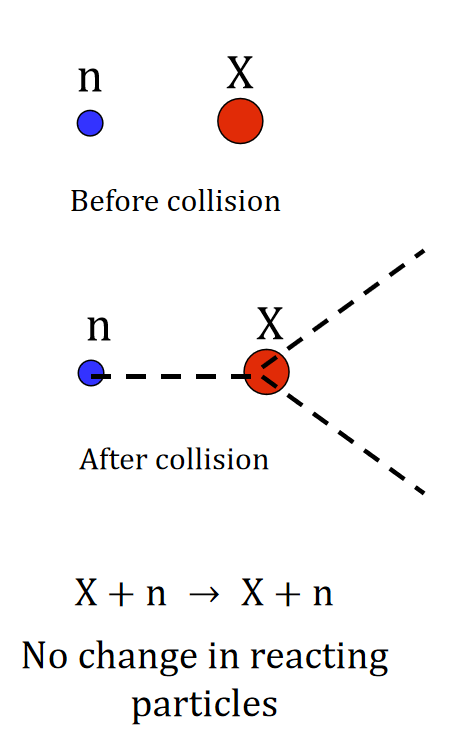
$$\begin{matrix} ^{1}_{0}\text{n} & + & ^{\text{A}}_{\text{Z}}\text{X} & \rightarrow & ^{\text{A}}_{\text{Z}}\text{X} & + & ^{1}_{0}\text{n} \end{matrix}$$
- Both ==kinetic energy== and ==momentum== are *conserved*
- Target nucleus remains in the *ground state*
- No change in reacting particles
- Typically occurs when a ==neutron== interacts with a ==light nucleus== *(such as hydrogen)*
- Can be ***modeled*** as a *billiard ball collision* between a ==neutron== and a ==nucleus==
- This is the type of reaction that mostly helps *fast neutrons* to be ***slowed down*** to ==low energies== in a reactor
```
Inelastic Scattering
```col-md
```
```col-md
flexGrow=2
===
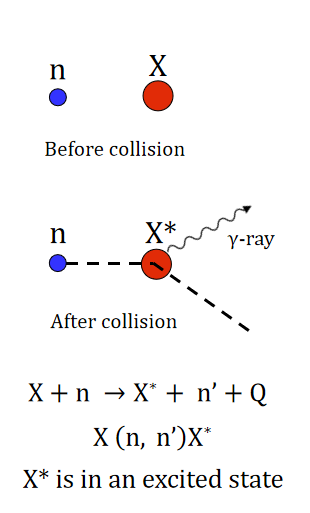
$$\begin{matrix} ^{1}_{0} \text{n} & + & ^{\text{A}}_{\text{Z}}\text{X} & \rightarrow & ^{\text{A}}_{\text{Z}}\text{X}^{\star} & + & ^{1}_{0}\text{n}' \end{matrix}$$
- Only the ==momentum== is *conserved*
- ==Rebounding nuclide== is left in an *excited energy state*
- Total kinetic energy is ***decreased*** before and after the collision
> - The difference accounts for the ==energy of excitation==
- The excited nucleus subsequently ***deexcites*** by ***emitting*** ==gamma $(\gamma)$ radiation==
> - Occurs when the neutron has kinetic energy ***exceeds*** the *excitation energy* of the nucleus
- $\text{n}'$ is the ==resulting final state of the neutron==
> - It loses some of its kinetic energy, however, it stays a neutron
- Important to note that inelastic scattering can emit ***both*** ==gamma rays== and ==heat==
```
Radiative Capture
```col-md
```
```col-md
flexGrow=2
===
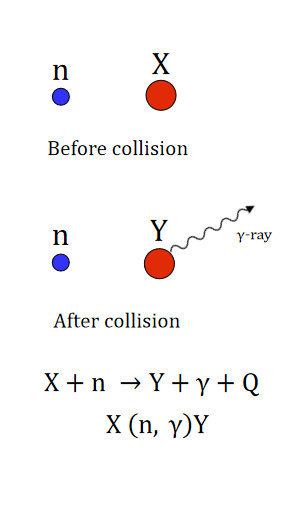
$$\begin{matrix} ^{1}_{0} \text{n} & + & ^{\text{A}}_{\text{Z}}\text{X} & \rightarrow ^{\text{A+1}}_{\text{Z}}\text{X} & + & ^{0}_{0}\gamma \end{matrix}$$
- The neutron is ***absorbed*** by the ==target nucleus== to form a higher isotope
> - This higher isotope is of ==mass A plus 1==, also in an *excited state*
- The new isotope ***de-excites*** by emitting ==gamma $(\gamma)$ rays==
- The neutron is *permanently lost* in this reaction
```
Charge and Neutron Production
```col-md
```
```col-md
flexGrow=2
===
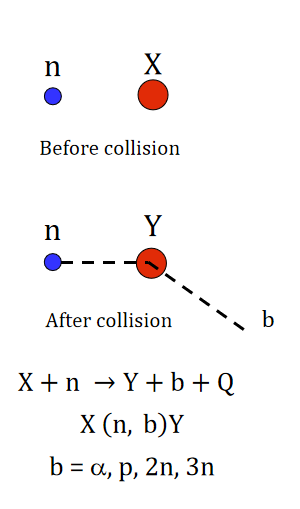
$$\begin{matrix} \begin{matrix} \underline{(\text{n},\text{p})} & \hspace{0.5cm} \rightarrow \hspace{0.5cm} & ^{1}_{0}\text{n} & + & ^{\text{A}}_{\text{Z}}\text{X} & \rightarrow & ^{\text{A}}_{\text{Z-1}}\text{Y} & + & ^{1}_{1}\text{p} \\ \\ \underline{(\text{n},\alpha)} & \hspace{0.5cm} \rightarrow \hspace{0.5cm} & ^{1}_{0}\text{n} & + & ^{\text{A}}_{\text{Z}}\text{X} & \rightarrow & ^{\text{A-3}}_{\text{Z-2}}\text{Y} & + & ^{4}_{2} \alpha \\ \\ \underline{(\text{n},\text{2n})} & \rightarrow & ^{1}_{0} \text{n} & + & ^{\text{A}}_{\text{Z}} \text{X} & \rightarrow & ^{\text{A-1}}_{\text{Z}} \text{X} & + & ^{1}_{0}\text{n} & + & ^{1}_{0}\text{n} \end{matrix} \end{matrix}$$
- In one instance, both a charge and a neutron may be produced at the same time
1) **Charge production** produces ==proton==, ==deutron==, or ==alpha particles==
2) **Neutron production** produces more neutrons other the one that was shot at the nucleus
> $$\begin{matrix} \text{2n}, \text{3n} \end{matrix}$$
- These are generally *threshold reactions*, which meanss a certain ==minimum neutron energy== is required for the reaction to occur
```
Fission Reaction
```col-md
```
```col-md
flexGrow=2
===
$$\begin{matrix} ^{1}_{0}\text{n} & + & ^{\text{A}}_{\text{Z}}\text{X} & \rightarrow & \text{FP1} & + & \text{FP2} & + & 2-3 ^{1}_{0}\text{n} \end{matrix}$$
- The most important reaction for nuclear energy
- When a neutron hits a *heavy nuclide (like $\text{U-235}$)*
> - The neutron gets ***absorbed*** in the heavy nuclide that gets *energetically* ***agitated*** *(or **excited**)*
> > - If the new energy state of the heavy nuclide is sufficient for it to ***split***, then it can split to cause ***fission***
- Most neutrons produced in fission are *fast*, having an average energy of ==$\text{2 MeV}$==
```